The problem
Mail threads, files and production decisions live in separate places. A generic CRM can record a lead, but does not model the technical path from an attached model to a production-ready order.
Active product
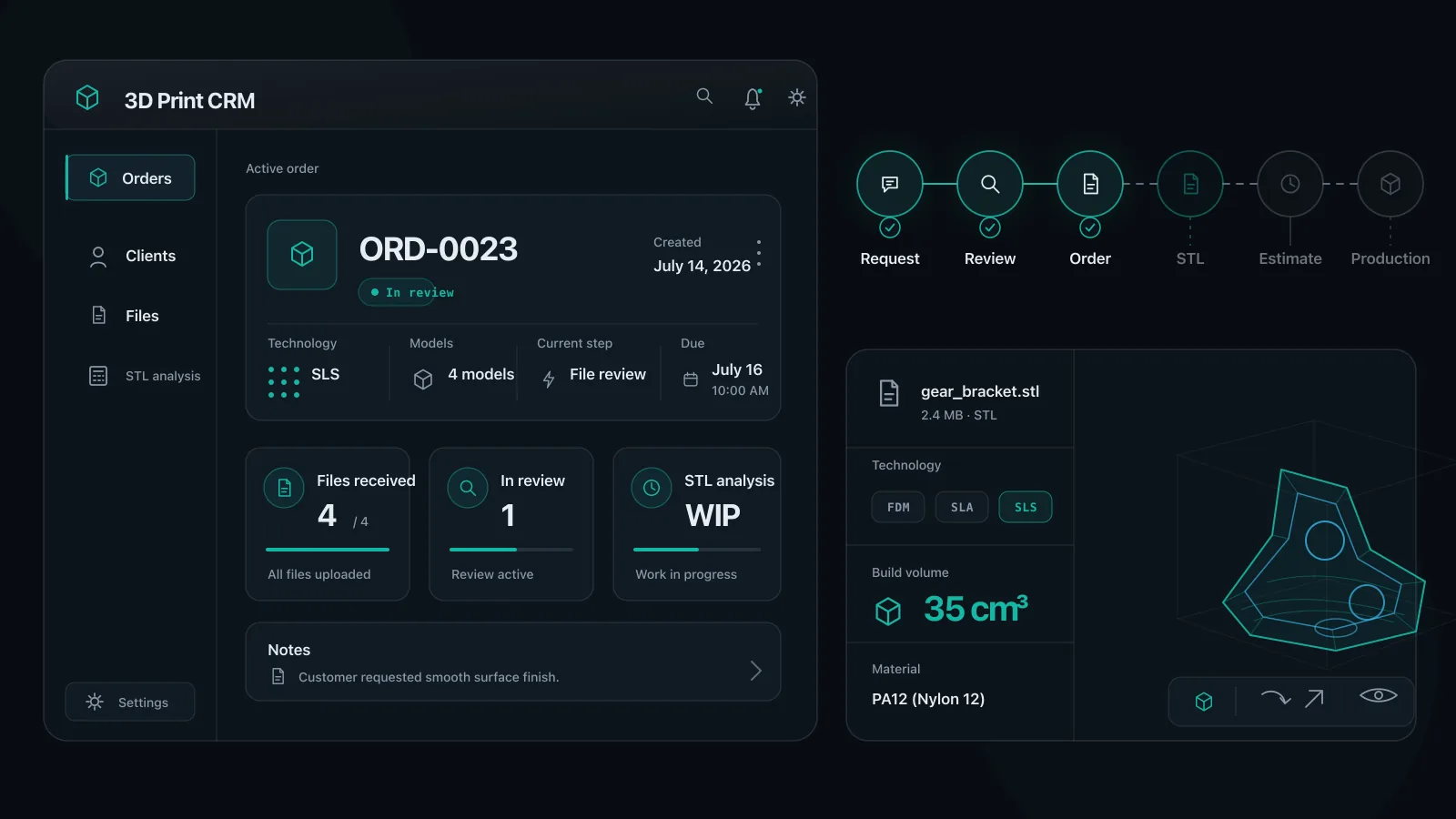
A system that takes email requests through manager review to confirmed production orders.
Context
A 3D-printing business receives requests through email, usually with attachments and incomplete technical details. A manager must inspect the request, clarify it, decide whether it can become an order, and keep its files and status understandable to the rest of the team.
Mail threads, files and production decisions live in separate places. A generic CRM can record a lead, but does not model the technical path from an attached model to a production-ready order.
Parsing and analysis may assist a manager, but cannot silently make commercial or production decisions. The workflow needs visible states, audit events and explicit confirmation.
Role & approach
I mapped the request-to-order flow, defined roles and state transitions, designed the service boundaries, and implemented the Go backend and integration layer. The UI is a focused manager workspace rather than a broad general-purpose CRM.
The order state machine is the source of truth. Integrations feed it; they do not define it.
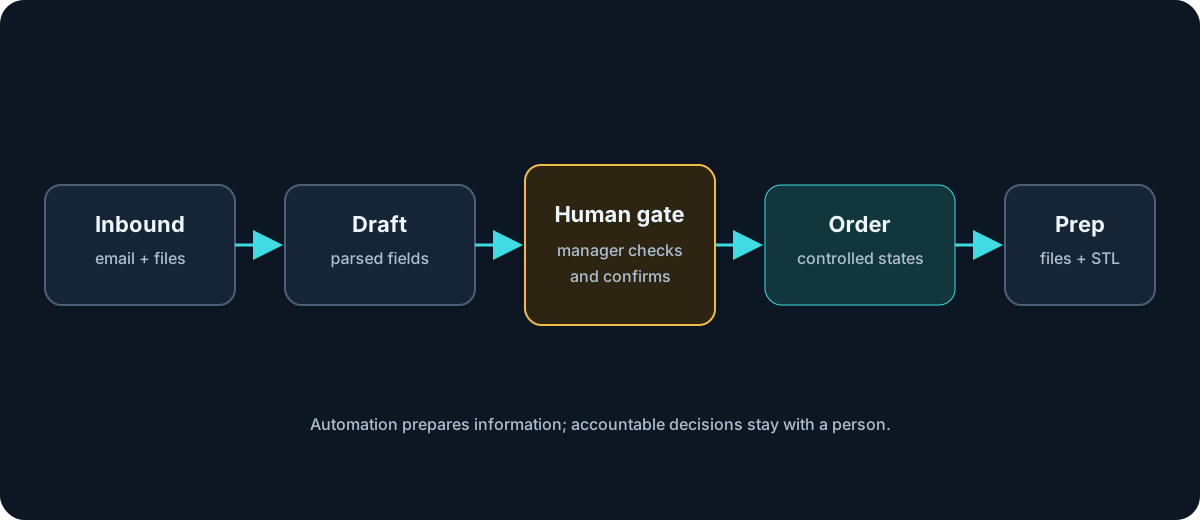
Inbound parsing produces a draft. Only an explicit manager action creates the order.
Storage, mail and model providers sit behind boundaries so local development and external services use the same core.
File transfer and model analysis run asynchronously, with visible statuses and retries instead of blocking the request path.
Workflow
An incoming message becomes a reviewable draft. Parsed fields and attachments reduce manual entry, while the manager remains responsible for confirming the customer, scope and order.
Architecture
The Go API owns authentication, permissions, order transitions and audit events. PostgreSQL keeps workflow state. Workers handle slower or failure-prone operations, while the React UI consumes the same APIs used for operational checks.
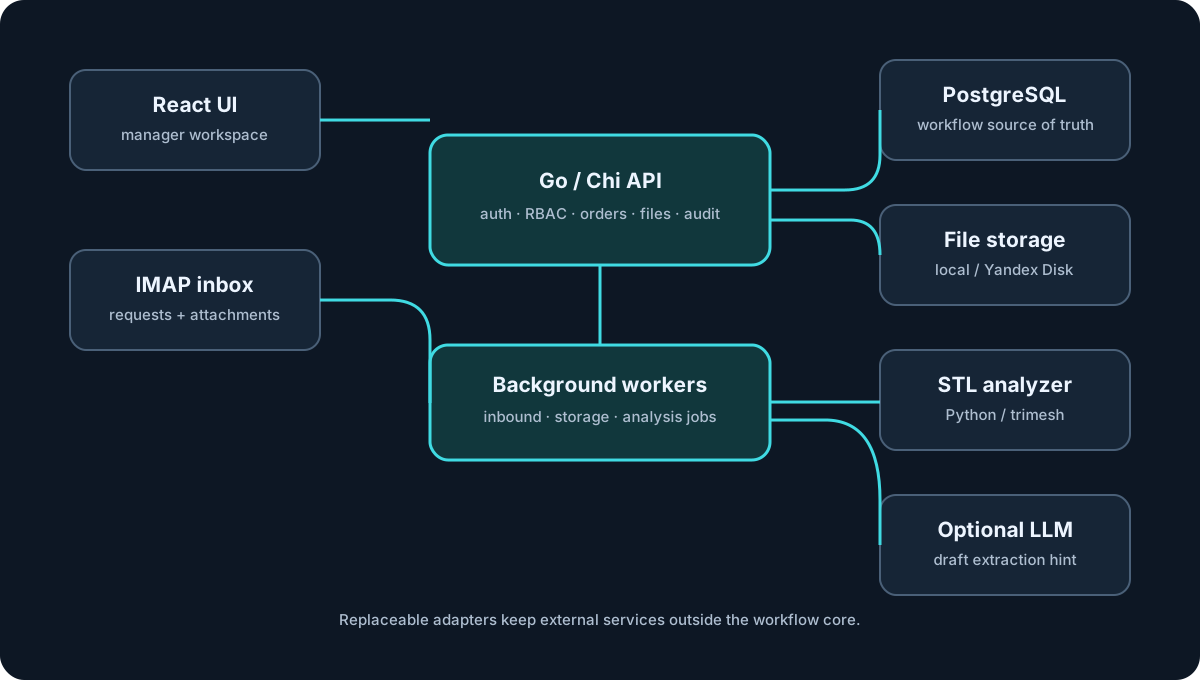
Why two languages? Go keeps the transactional application and adapters cohesive; Python/trimesh provides a mature geometry toolkit behind a narrow analysis contract.
Delivery status
The core request-to-order flow works. File processing is ready for pilot acceptance; estimation and production operations come later.
JWT/RBAC, users and customers; order creation and controlled states; files and pluggable storage; inbound drafts with explicit manager confirmation; jobs and audit events.
Archive safety checks, STL metrics, watertight warnings, preview jobs and a Three.js viewer are implemented and covered by tests. The next step is a pilot with representative files.
Print types, tariffs, express and detailed estimation, readiness checks and technologist data are designed but not yet implemented.
Tasks and Telegram reminders, production history, management dashboard, diagnostics, backup and production deployment remain future work.
Trade-offs
Next
The next step is to test archive handling, STL analysis and the viewer on representative files, then settle the estimation rules. Usage metrics will only make sense after the workflow is used in day-to-day work.
Not shown: customer data, credentials, repository access or real prices. The diagrams and cover use synthetic data.